



This past year I had the remarkable opportunity to be part of the Diocese of Calgary’s synodal leadership team. The task was enormous; the way forward was uncertain and the learning curve was straight up! Though this territory was uncharted for me, I was inspired immediately when I read the Vatican documents explaining the synodal process. The goals were aspirational and shared through the language of scripture and faith. I was moved. I was hooked! I remember thinking to myself (and saying to others), “How do these guys at the Vatican have the ability to really ‘get us’? To understand what we need and long for? How do they express it in words that clarify God’s love and the mission of the Church in such an effective way?’’
As I went through my bookcase a few months ago attempting to write a homily (the key word here is “attempting”), I came across an old copy of the famous book by Reinhold Niebuhr called Christ and Culture.
Most people would know Niebuhr through his adapted Serenity Prayer, used in likely too many Church basements for over eight decades:
“God, grant me the serenity to accept the things I cannot change, courage to change the things I can, and the wisdom to know the difference.”
Christ and Culture is much like this prayer - it delves into how Christianity can change culture; and how culture, in turn, can change Christianity. It questions who, what, where, when, and on what side changes are made, and whether these changes are to the assistance of Christianity and the general population. During this sidetrack from writing my sermon, I could see that there was also much debate about what Niebuhr meant. Some have suggested that he proposed that Christianity should rarely influence culture. In contrast, others have said that he presents an overbearing archetype where Christianity is too influential over the general culture. And, in re-reading it, I could see how people could reach both conclusions.
After scanning through this book again, however, I was struck that this is often how any conversations and dialogues go: someone interprets you as wanting to change something, while another person seems at home. For example, a church congregation may be very comfortable hearing quotes from the Bible, but this done in another place would likely raise eyebrows. This is because the thing being said (whether it be something from Christianity or anything else) questions my agreeance with it. And because of this, ultimately, education is a question of what my life should be and what I am to do with my freedom to believe and act on what is taught. As the catechism says about humans: “God created man a rational being, conferring on him the dignity of a person who can initiate and control his actions” (CCC 1730). Openness and freedom are also at the center of all we will; as Hegel said from a purely philosophical perspective, “Freedom is the fundamental character of the will, as weight is to matter...” Openness and freedom are at the very core of who we are as human beings.
This openness and freedom is echoed in the fantastic work of Catholic schools and organizations. Catholic schools, day in and day out, seek to provide a humanity-fostering venue whereby openness to parentally-requested spiritual perspectives are met in dialogue with all other views. This is furthered by the fantastic work of our trustees in order to create an authentic culture of dialogue and openness. Catholic school boards in Alberta have been at the center of this beautiful dialogue that “we must enter into,” as St. Paul VI says (Ecclesiam Suam, 65).
One document that is particularly helpful in guiding us as we work within our society and in accordance with the requests of parents (i.e. to educate their children in a Catholic atmosphere) is from the Vatican Dicastery for Interreligious Dialogue. This document, Dialogue and Proclamation (73-74), describes the various barriers that can emerge as we seek to create places of total openness and respect. Catholic school boards have done an excellent job addressing these barriers. These include following the internal barriers within Catholicism:
1. Christians who fail to proclaim the Deposit of Faith because of fear or another reason. Trustees have done a great job addressing these in the province of Alberta through prioritizing Faith Formation for students and teachers. Expectations of literacy for both scripture and the tradition of the apostles are set in the Teacher Quality Standard, where permeation of knowledge of the Deposit of Faith is expected and evaluated at a local level by suitable supervisors.
2. Christians who cannot see God as the source of goodness from other perspectives. As St. Augustine says aptly, “all goodness is God’s”. We make sure that schools distinguish between truths that Catholics declare and the ability to see goodness in other approaches and the “seeds of truth” offered (St. John Paul II, General Audience, Sept. 9, 1998).
3. Christians who wrongly connect a culture with Catholicism and thereby seek to encourage a particular culture rather than Catholicism. Our schools strive to address areas in former years where Christians have failed to live up to the expectations of the Deposit of Faith in our history. This work has been done by incorporating indigenous education into all areas of our schools, acknowledging the genocide done to indigenous peoples in the history of Canada (Pope Francis, Flight to Rome, July 30, 2022), as well as proper theological responses to the repugnant evil of racism.
4. Christians who have not changed their lives previously to believe and live the Gospel message and the Deposit of Faith. School boards take part in various initiatives to encourage teacher involvement in their parish life. This has included pastoral and spiritual growth plans made with parish involvement. And collaborative work, through ACSTA, with the Bishops of Alberta and the NWT.
The external barriers to creating places of openness, respect, and freedom include:
1. “The weight of history” where Christians have not acted following what Christ and the Apostles taught, and thus fear and suspicion arise when Christians teach. We strive to keep the teaching and living of the Deposit of Faith central in schools. The instruction of history in various subjects is honest when Christians fail to live up to the expectation set up by Christ and His Church.
2. The identification of Catholicism with a particular culture or political system. Our schools have been clear in their close relationships with all peoples and politicians that, following the example of Christ (Mk. 12:17), Catholics work with people of all political views.
3. Indifferentism (reinterpreting any ideology/religion as teaching the same things, despite the counterclaims of an ideology/religion), Relativism (stating that religious claims to truth are only true for a particular individual), and Syncretism (a western cultural attempt to reinterpret all religions according to contemporary western philosophy). Trustees have worked with various agencies such as ACSTA to ensure school boards understand their clear Catholic identity. They genuinely respect that our parents choose Catholic schools expecting that we will abide by our unique “branding” that speaks and addresses the current ideologies of our society.
May we be guided by the Holy Spirit, the prayers of St. Mary and all the angels and saints as we seek to continue to create educational places that address these barriers in openness, kindness, and respect.
Fr. Adrian is the Ordained District Chaplain of the Calgary Catholic School District and also serves as the Vicar for Lay Associations and the Ecumenical and Interreligious Coordinator for the Diocese of Calgary.
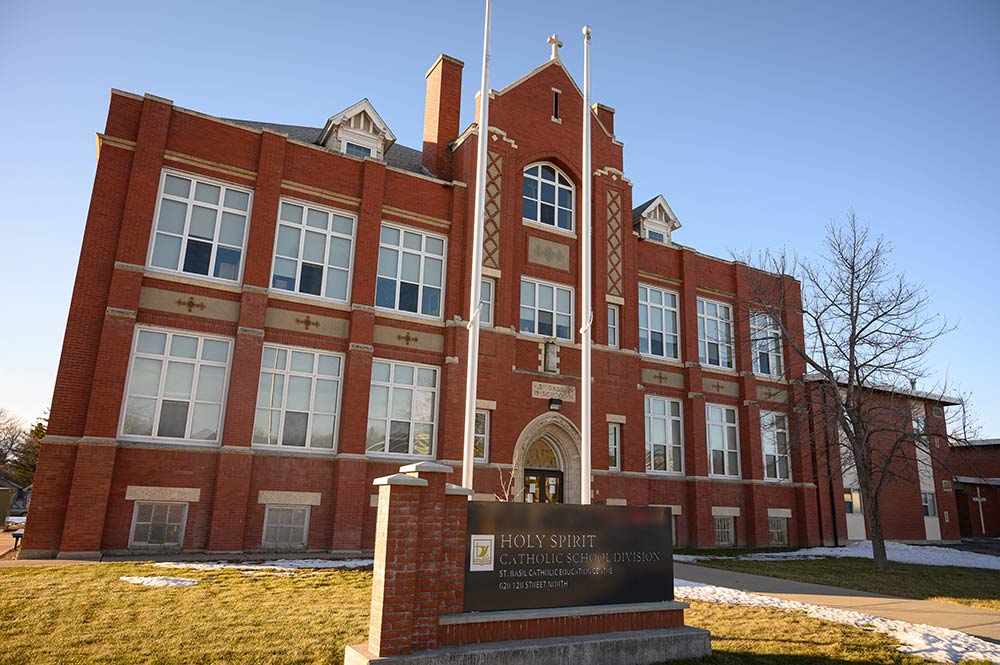
As part of the global Church’s preparation for the 2023 assembly of the Synod of Bishops each diocese throughout the world has summarized their experience of the first phase of reflection and dialogue on Church: Communion, Participation, and Mission (“synodal process”). It was a process of prayer, listening, and dialogue in each local Church guided by the Holy Spirit. In the Assembly of Western Catholic Bishops (AWCB) Synod Synthesis report the importance of faith education, formation and catechesis. “Access to Catholic Schools is varied from province to province, but where schools exist, they are generally expected to be responsible for catechesis. Greater collaboration between parish and school is needed to assist parents in assuming this role.” In order to achieve this goal, the report states, “suggestions focus on improving faith formation in Catholic schools, strengthening the connection between schools and parishes, and supporting school teachers in living their faith”.
Catholic schools in Alberta have a distinct mission; providing an education within the framework of the provincial curriculum, and doing so in an atmosphere that is permeated by faith. The role of the principal as a leader of faith within the school community is essential in fulfilling this mission, as they are responsible for overseeing teaching and learning, while at the same time nurturing the spiritual growth of students, staff, and the broader school community. My doctoral research focused on the role of the principal as faith leader within Alberta’s Catholic schools. In this brief article, I will attempt to delve into the importance of this role and identify a few key competencies and responsibilities of principals in Catholic schools.
Perhaps the most fundamental aspect of the principal's role as a faith leader is the promotion of Catholic teachings and values throughout the school. This involves not only ensuring that Catholic doctrines are integrated into the curriculum, but also that they are incorporated into the daily life of the school. This can include the use of prayers and religious observances in school events, the promotion of community service and social justice initiatives, and the encouragement and support of faith-based extracurricular activities.
Another important responsibility of the principal as a faith leader is the cultivation of a strong Catholic culture and identity within the school. This includes creating an environment that is welcoming and inclusive to students, staff, and families of all backgrounds, while also celebrating the unique aspects of Catholicism. It also involves modeling and encouraging behavior that is consistent with Catholic values, such as kindness, respect, and compassion. Convey (2012) proposes a fairly structured model regarding the key components of Catholic identity which illustrates the basic components of both content and culture:
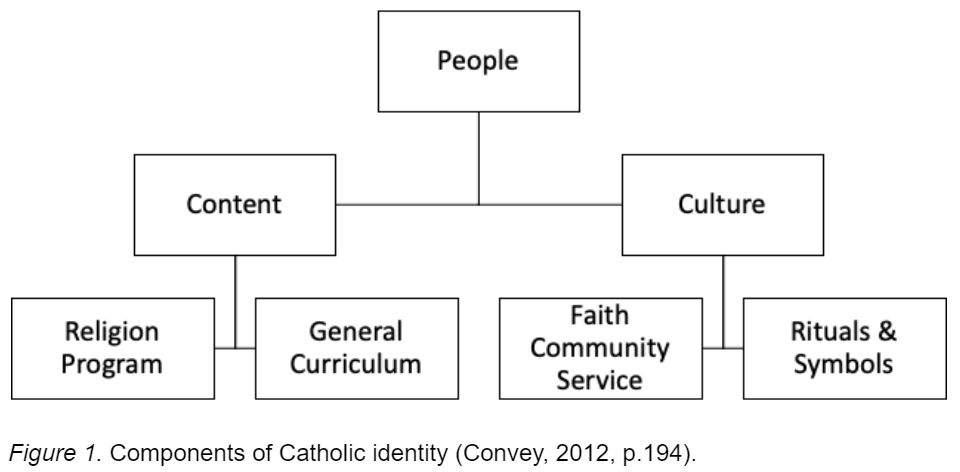
According to Convey (2012), some of the most important elements of Catholic school identity include a strong faith community, the teacher of religion being Catholic, starting the day with prayer, and Catholic teachings being presented in religious education courses, but also integrated into the general curriculum to the greatest extent possible. As not only a faith leader, but also the instructional leader in the school, it is the responsibility of the principal to oversee all aspects of Catholic identity and culture, from religious instruction to faith activities, liturgies, and service projects.
In order to fulfill these responsibilities, the principal must possess a deep understanding of Catholic teachings and their relevance to modern society. This requires ongoing professional and faith development, as well as a willingness to engage in theological reflection and dialogue with others in the school community. Additionally, Catholic school principals are called to model Catholic values and teachings in their own life. This involves living out the faith in their personal and professional life and being a visible and authentic example of faith for the school community.
In addition to promoting Catholic teachings and values within the school, the principal as a faith leader must also work to build strong relationships with the broader Catholic community. This can involve collaborating with the local parishes, diocese or eparchy, and other Catholic organizations (i.e., Catholic Social Services, Society of Saint Vincent de Paul, etc.) to promote shared goals and initiatives. It also involves being an active participant in diocesan or eparchial events and initiatives, and fostering a sense of connection between the school and the wider Catholic community.
With so much good news to share, the principal as a faith leader must be able to effectively communicate the school's Catholic identity to stakeholders both within and outside of the school. This requires the development of clear and compelling messaging that conveys the school's mission and values, as well as the successes and challenges of the school's faith-based initiatives. It also involves actively engaging with the media and other external stakeholders to promote the school's Catholic identity and achievements. This requires leadership and guidance at the division level, regardless of whether or not there exists a dedicated communications individual or department, to ensure that communication meets a basic standard and aligns with the mission and vision of the school jurisdiction.
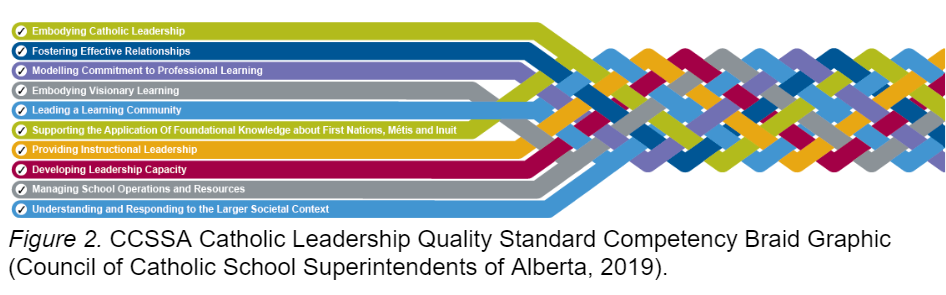
The principal's role as a faith leader in Alberta's Catholic schools is a complex one that requires a broad range of skills and expertise. By promoting Catholic teachings and values, cultivating a strong Catholic culture within the school, building relationships with the broader Catholic community, and effectively communicating the school's Catholic identity to stakeholders, the principal as a faith leader plays a critical role in shaping the faith and character of the school community. What’s more, is that this must all be accomplished while attending to all other elements of leadership in the school, as articulated in both the Alberta Education Leadership Quality Standard (LQS) and its Catholic sister document, the Council of Catholic School Superintendents of Alberta (CCSSA) Catholic Leadership Standard, which adds to the LQS the component of Embodying Catholic Leadership and permeates faith through all other aspects of school leadership. The interconnectedness of all aspects of leadership is depicted in the below graphic, which was adapted from a similarly-styled graphic developed by the College of Alberta School Superintendents.
In conclusion, the role of the principal as a faith leader in Alberta's Catholic schools is multifaceted and essential to fostering a strong Catholic identity within the school community. Through integrating Catholic teachings into the curriculum, actively engaging the school community in the faith, promoting service to the community, working closely with clergy, families, and Catholic agencies, and modeling Catholic values and teachings, the principal is able to create a Catholic learning environment that inspires students and staff to live out their faith in their personal and professional lives. To generalize, the faith leadership role of the Catholic school principal can be defined as living gospel values and serving as a Catholic role model to the school community while working to permeate faith into all aspects of the work of school management and leadership. Sounds simple enough.
References
Convey, J. J. (2012). Perceptions of Catholic identity: Views of Catholic school administrators and teachers. Catholic Education: A Journal of Inquiry and Practice, 16(1), 187-214. doi:10.15365/joce.1601102013
Council of Catholic School Superintendents of Alberta. (2019). CCSSA Catholic leadership quality standard competency braid [Graphic].
Dr. Clint Moroziuk has worked in Catholic education for the past 26 years and has served as the Chief Superintendent of Greater St. Albert Catholic Schools since 2020. He holds a Bachelor of Education from the University of Alberta, a Master of Arts in Education from the University of Phoenix, a Master of Religious Education from Newman Theological College, and a Doctor of Education from the University of Calgary. He recently collaborated on designing a course for the Master of Education program at St. Mary’s University in Calgary and looks forward to serving as an instructor in that program in the future.
The Three Forms of Permeation
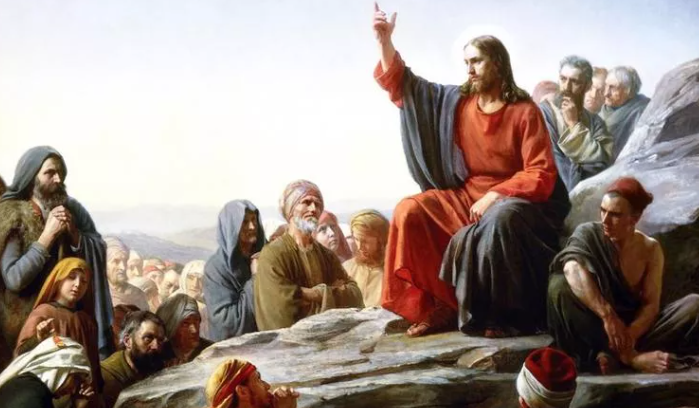
Previously on this blog, I reflected about what it means to say that Catholic schools should be characterized by permeation. (Some, with good reason, prefer the word “integration,” and, if you are one of these people, you can feel free to mentally replace “permeation” with “integration” every time it appears in this post.) I suggested that there are three forms of permeation: Worldview permeation, worship permeation, and witness permeation.
Since writing that post, it has occurred to me that these three forms of permeation roughly correspond to the three offices of Jesus Christ: Prophet, Priest, and King.
- The prophet’s mission was to preach the law of God, to explain to the people of God what that law called on them to do in every aspect of their lives, and to remind them of God’s promises. This corresponds to worldview permeation.
- The priest’s function was to make the sacrificial offerings to God and to officiate over the people’s liturgical celebrations. This corresponds to worship permeation.
- The king’s job was to rule the people in accordance with God’s laws and to execute justice, especially on behalf of the poor and downtrodden. This corresponds to witness permeation.
Jesus fulfills all these roles, and permeation is therefore a participation in the ministry of Jesus Christ as applied to the work of education. (This should remind us that permeation is also impossible unless it occurs through Jesus Christ, Who has sent His Spirit to empower us to carry on His mission.)
But the question then arises of who is supposed to do this work. The Magisterium (that is to say, the Church exercising her authority to teach) has consistently stated that the task of permeation in a school falls primarily to its teachers–not to administrators, trustees, parents, students, or support staff (though every one of these groups has an important role to play as well), but to the teachers. Having solid Catholic teachers may not be a sufficient condition for a permeated school (for example, you could have a school full of great Catholic teachers who are stifled by bad policies), but it is a necessary one.
What Kind of Teachers?
The Catholic School Superintendents of Alberta (CCSSA) has recognized this and have produced excellent criteria for identifying the kind of teacher a school needs if permeation is going to take place there. (Remember, permeation is the work of the Holy Spirit, not us, but God works through instruments, and so a principal will want to hire teachers who are able and willing to serve as His instruments.)
One such metric is the Catholic version of the Teaching Quality Standard (TQS), which takes the provincial standards for teacher professionalism and adds various indicators that are particular to Catholic education. For example, the TQS used by public schools lists “Engaging in Career-Long Learning” as a competency teachers should strive for. In addition to the indicators listed in that version, the Catholic TQS includes “[s]eeking personally to grow in his or her spirituality and faith, understanding of Catholic teachings and doctrine” as one of the signs of this competency.
This is helpful, but it is worth remembering that the TQS is a secular set of criteria onto which the Catholic TQS imposes a distinctively Catholic perspective. This is fine, as far as it goes, but one wonders if there is not a criteria for Catholic teachers that starts with the question, “What kind of teacher can God use for permeation?”
One possibility here is found in a helpful CCSSA document called “The Excellent Catholic Teacher.” To tease out the criteria for such a teacher, this text essentially works backwards from Archbishop Miller’s five marks of a Catholic school, that is: A Catholic school is (1) grounded in a Christian anthropology, (2) imbued with a Catholic worldview, (3) animated by a faith-infused curriculum, (4) sustained by Gospel witness, and (5) shaped by a spirituality of communion. Based on these, the CCSSA document identifies the “five marks of an excellent Catholic teacher”:
- “An excellent Catholic teacher recognizes that each person has an eternal destiny and is created in the image of God.”
- “An excellent Catholic teacher expresses and develops a living Catholic vision of the world.”
- “An excellent Catholic teacher permeates faith and wisdom through pedagogy and curricular content.”
- “An excellent Catholic teacher witnesses to others a life lived in relationship with Jesus Christ.”
- “An excellent Catholic teacher contributes to a spirituality of communion.”
This is undoubtedly a great list of things a Catholic teacher should do. After all, these are marks of an excellent Catholic teacher. By definition, a mark is something that is visible; it sets what is marked apart for the observer. An alert administrator should be able to observe an excellent Catholic teacher doing all of these things.
At this point, however, the philosophy teacher in me rears his punctilious little head and fussily insists on making two observations.
One of these observations is that there is such a thing as the fallacy of division. This is the logical mistake of assuming that, because something is true of a whole, it must be true of each of the parts of that whole. An example of this fallacy expressed in syllogistic form would be:
- A car is capable of self-propulsion.
- A steering wheel is part of a car.
- Therefore, a steering wheel is capable of self-propulsion.
Obviously, this is an error. The steering wheel, like all the other parts of the car, has a specific function; when all the parts are performing those functions correctly, then the whole car has the power of self-propulsion. This is the principle of emergence: Powers and properties that are not present in the individual parts emerge when they come together as a whole. “The whole is greater than the sum of its parts,” as they say.
I worry that we may be committing the fallacy of division if we reason thusly:
- A permeated Catholic school has five particular marks.
- Teachers are part of permeated Catholic schools.
- Therefore, each teacher will also have those five particular marks.
To put this differently, what makes sense when describing a whole school can be a bit puzzling when applied to a particular teacher. It makes sense to say a school, as an institution, should recognize the supernatural dignity of each student as well as be animated by a faith-based curriculum. On the other hand, for an individual, isn’t recognizing that each person is made in God’s image (the first mark) just an extension of having a living Catholic vision of the world (the second mark)?
In the same vein, couldn’t there be qualities an individual Catholic teacher must possess (such as classroom engagement skills) that can’t be predicated of the whole school? If so, then using the five marks, which apply to the entire institution, to understand the work of a single teacher runs the risk of leaving out qualities which are distinct to a teacher’s work. It is interesting that “The Excellent Catholic Teacher” includes an appendix on the Catholic teacher’s spiritual commitments and pedagogical style, perhaps indicating that the five marks do not adequately cover all the characteristics we should expect to find in a Catholic teacher.
The other observation comes from the Catholic philosophical tradition. As mentioned, these five marks refer to what a Catholic teacher does. But where does that doing come from? The medieval Scholastics, when working out their Christian philosophy of the universe, formulated a rule: operari sequitur esse. Roughly translated, this means that “the actions of a being flow from the nature of that being.” A teacher can only do the kind of actions described in the five marks if they already are a certain kind of person. 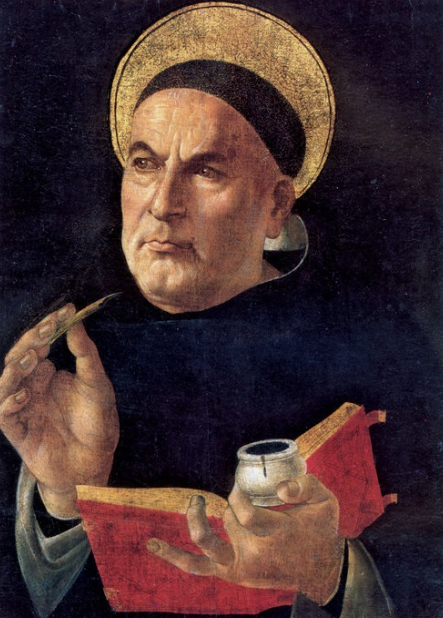
To put this another way: You can’t just ask any given teacher to be able to do all these things. A teacher who lacks certain personal and professional qualities won’t be able to permeate faith and wisdom or witness to a life lived in relationship with Jesus Christ, just like a teacher without certain personal traits won’t be able to work in a Suzuki music school or a hockey academy. (Notice: Even if a teacher were a good educator and a fan of hockey, that wouldn’t mean he was suited to teach at a hockey academy. By extension, is a teacher ready for permeation just because she is a good teacher and a devout Catholic?) Before looking at whether a Catholic teacher does these things, we should consider what kind of teachers can do these things.
To that end, I would suggest that, beyond the marks of a Catholic teacher, we should be on the lookout for teachers with certain kinds of traits, personal characteristics that give rise to the actions from which a permeated school emerges.
The Five Traits of a Catholic Teacher
The Church’s Code of Canon Law lays down certain rules about who should be allowed to teach in Catholic schools. Canon 804 §2 declares that religious educators (which really means all teachers in a Catholic school, since all education in a Catholic school has a religious dimension) “are outstanding in correct doctrine, the witness of a Christian life, and teaching skill.” The 1982 Vatican document Lay Catholics in Schools: Witnesses to Faith add two further criteria: Catholic teachers should be able to work in community, which means collaborating with colleagues as well as with parents (para. 34) and “develop in themselves, and cultivate in their students, a keen social awareness and a profound sense of civic and political responsibility” (para. 19).
From these Church documents, then, we gather that a Catholic teacher must possess at least five traits:
- Knowledge of Catholicism
- Christian witness in life
- Pedagogical knowledge
- Skill in collaboration
- Sense of civic responsibility and need to instill this in students
There are two groups of traits here. The first two are unique to Catholic teachers. The last three can also be seen among non-Catholic teachers, but will look different in a Catholic teacher. I call these Permeation-Unique Teacher Traits and Permeation-Infused Teacher Traits, or PUTTs and PITTs. (Of course, you could also call them IUTTs and IITTs.) The PUTTs inform the other three traits and turn them into PITTs.
All teachers should be skilled in pedagogical technique. However, two equally skilled teachers could have two completely different pedagogical strategies. This matters because different pedagogical methods have different philosophies embedded in them, and some of those philosophies are more compatible than others with the Catholic view of reality. To take just one example: In the realm of early childhood education, compare the pure constructivism of the Reggio Emilia method, which developed in non-Catholic schools, to the emphasis on structured play-based learning in a Montessori classroom. This difference is not unrelated to the fact that Maria Montessori was a devout Catholic and therefore had a belief in objective truth that may not be present in the Reggio pedagogical philosophy. This does not mean a Catholic teacher in an early learning classroom must strictly follow Montessori and learn nothing from Reggio, but it does mean she will be aware of whether her pedagogy is in accordance with the Catholic worldview. This third trait is therefore to be understood through the lens of the first trait.
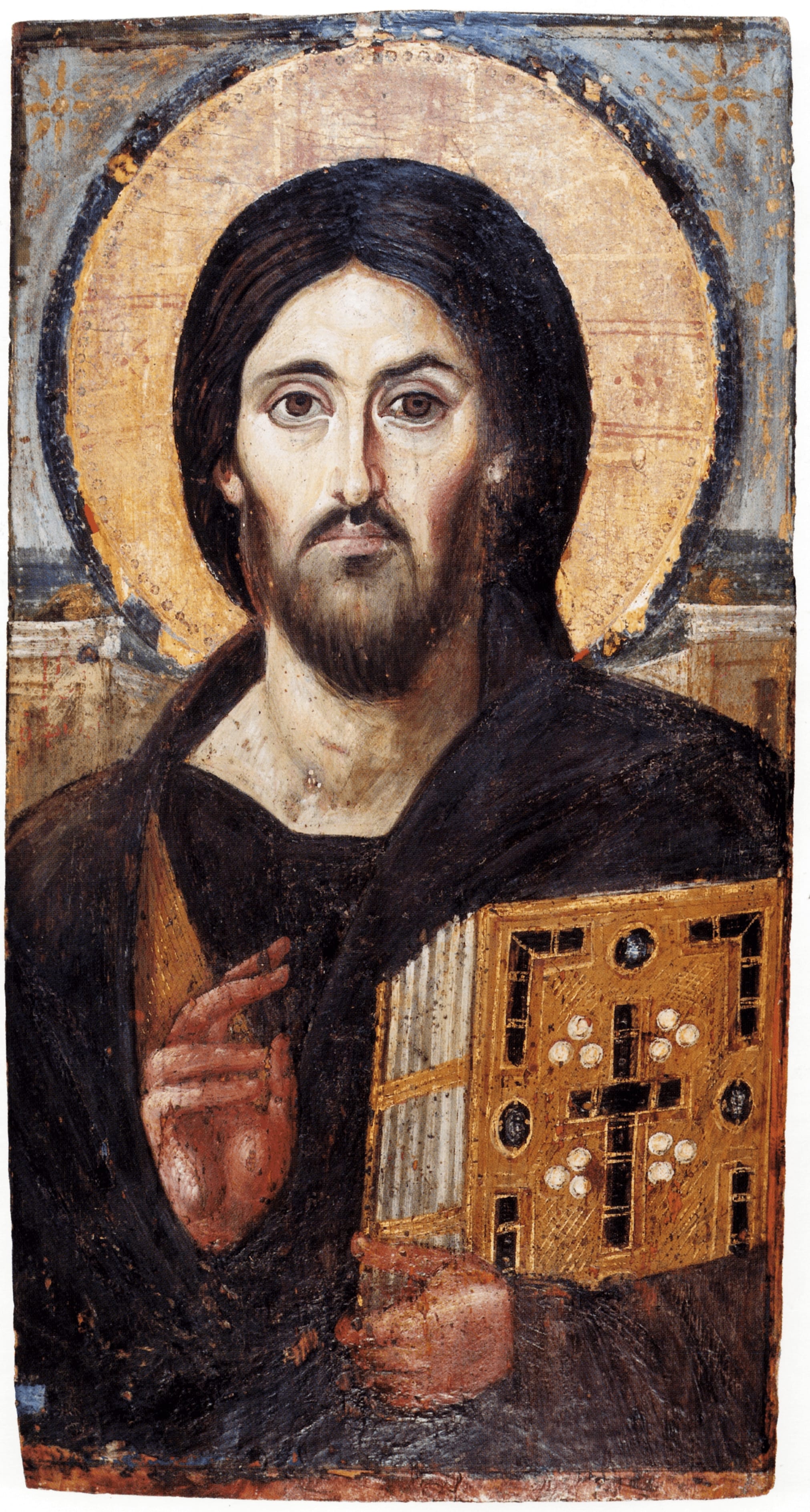 All teachers should have skills in collaboration, but, for a Catholic teacher, this is part of a broader “spirituality of communion,” to go back to the phrase of “The Excellent Catholic Teacher.” For her, this will be both an exercise in professionalism as well as a recognition that the work of Catholic education is always ecclesial (that is to say, rooted in the broader community of the Church). The Catholic teacher recognizes that she is part of the body of Christ and plays an important but subservient role in a bigger plan that God is working out in her school community. In collaborating – which often takes great humility – the Catholic teacher testifies by her actions that permeation is ultimately God’s work, not hers. The second trait therefore shapes this fourth one.
Finally, all teachers should be concerned for social justice, but what exactly – for a Catholic teacher – social justice looks like, and how to bring it about, is defined by Catholic Social Teaching as outlined in the Compendium of the Social Doctrine of the Church. Her vision of what is wrong with politics and the economy, and the steps we need to take to address those problems, will therefore look (at least a little different) than it does for her counterpart in a secular school. To wit: the secular teacher may not see a connection between contraception and climate change – both symptoms of what Pope Francis calls “the throwaway culture” (para. 22 of Laudato Si) – or between prayer and social activism; a Catholic teacher, however, will perceive these connections and model the inseparability of love for God and love for neighbour to her students. Both the first and the second traits are at play in this fifth one.
A teacher who possesses these five traits, or who is being formed in them and allowing God to develop them in her, is ready to participate in Christ’s prophetic, priestly, and kingly ministry in her work. A school staffed with teachers like her is one where permeation will emerge and the five marks will be visible for all to see.
Brett Fawcett teaches for Elk Island Catholic Schools at the Chesterton Academy of St. Isidore, and is a doctoral student at the University of Calgary.
Page 3 of 6